 English

Do Fixed Teeth on Implants Need Cleaning Too? How to Care for Them
Fixed teeth on implants still need daily hygiene and professional maintenance. Learn what to ask about cleaning and check-ups.
Getting fixed teeth back can make you think again about a meal, a conversation or a smile in a photo. Cleaning might seem like a secondary detail. Still, it helps to picture the next day: you are in front of the mirror and need to know how to care for that new restoration.
Implants do not eliminate oral care
Peri-implant diseases affect the tissues around implants. Peri-implant mucositis is inflammation of the soft tissues without bone loss; peri-implantitis includes inflammation and deterioration of the supporting bone. Redness and bleeding when brushing are signs that deserve a check-up. You cannot tell these conditions apart just by looking at the prosthesis (American Academy of Periodontology, n.d.).
Care aims to keep those tissues healthy, in addition to cleaning the visible teeth. The AAP notes that plaque control, a history of periodontal disease, smoking and diabetes are part of the risk assessment. Having implants does not make professional check-ups unnecessary (American Academy of Periodontology, n.d.).
A technique for your prosthesis, not a universal recipe
The European Federation of Periodontology S3 clinical guideline recommends tailoring care to the prosthesis design and the person’s abilities. It also proposes that patients demonstrate their technique to the professional, to confirm they can do it and to reinforce it periodically. Some of these recommendations rely on expert consensus; they do not mean there is one superior tool for every mouth (Herrera et al., 2023).
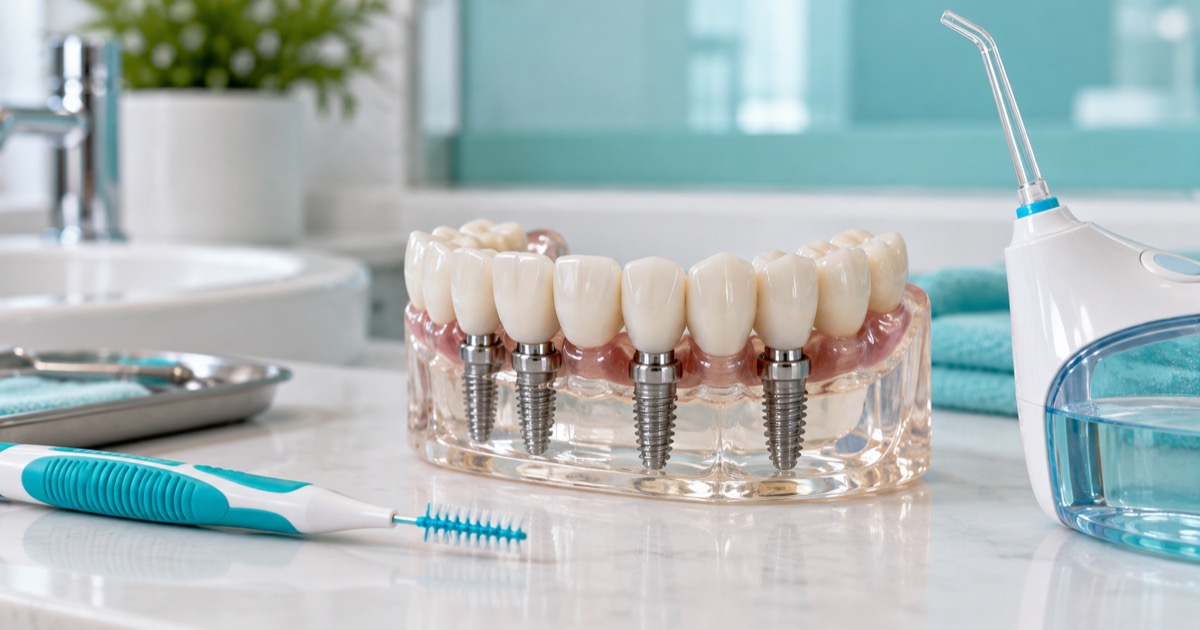
Ask to be shown where to place the brush, how to reach the spaces and which tool goes with each area. Then do it yourself during the appointment. An explanation you understand but cannot repeat at home needs adjusting. Mention whether you have trouble seeing, holding a tool or reaching a space.
The EFP’s patient guidance advises daily brushing and cleaning between the teeth with suitable tools, plus regular check-ups. It does not present a water flosser as a universal substitute for that routine. If one is recommended to you, clarify what role it plays in your case and which other measures you should keep up (European Federation of Periodontology, n.d.).
Does it matter for All-on-4 and All-on-6 too?
Yes: access for hygiene is part of planning a full-arch fixed prosthesis, according to the ITI consensus (Polido et al., 2018). When comparing proposals, add one very specific question: “How will I clean this restoration every day?”
Ask for an answer tied to your design. The names All-on-4 and All-on-6 do not on their own explain how you will use the tools, which areas will need more attention or what check-ups you will have. Keep the instructions with your treatment information so you can refer to them later.
Maintenance starts when you plan treatment
The S3 guideline proposes a program of care and periodic assessment of the tissues around implants (Herrera et al., 2023). Ask for an individual schedule and what will be checked, how a professional cleaning will be coordinated and what to do if changes appear before your appointment.
If you need to travel, include those check-ups in your planning. Don’t try to take apart or adjust the prosthesis yourself; ask the team about any intervention that is needed. The goal is to leave knowing how to care for it and whom to ask. A rehabilitation is fully understood when you can also explain its maintenance. To continue, review the differences between All-on-4 and All-on-6 and how to organize follow-up once you are home.
Want us to review your case? At The Special Teeth we see patients in English and Spanish, about 10 minutes from the San Ysidro border crossing, and we accept Aetna and MetLife PPO dental insurance. Learn more about dental implants in Tijuana or book your evaluation.
References
American Academy of Periodontology. (n.d.). Peri-implant diseases. Retrieved October 9, 2026, from https://www.perio.org/for-patients/periodontal-treatments-and-procedures/dental-implant-procedures/peri-implant-diseases/
European Federation of Periodontology. (n.d.). FAQs: Dental implants and peri-implant diseases. Retrieved October 9, 2026, from https://www.efp.org/for-patients/dental-implants/faqs/
Herrera, D., Berglundh, T., Schwarz, F., Chapple, I., Jepsen, S., Sculean, A., Kebschull, M., Papapanou, P. N., Tonetti, M. S., Sanz, M., & EFP Workshop Participants and Methodological Consultant. (2023). Prevention and treatment of peri-implant diseases: The EFP S3 level clinical practice guideline. Journal of Clinical Periodontology, 50(S26), 4–76. https://doi.org/10.1111/jcpe.13823
Polido, W. D., Aghaloo, T., Taylor, T. D., & Morton, D. (2018). Number of implants placed for complete-arch fixed prostheses [Consensus statement]. ITI Consensus Database. https://academy.iti.org/academy/consensus-database/consensus-statement/-/consensus/number-of-implants-placed-for-complete-arch-fixed-prostheses/1701