 English

Why Do Your Dentures Move? What Can Be Adjusted and When to Replace Them
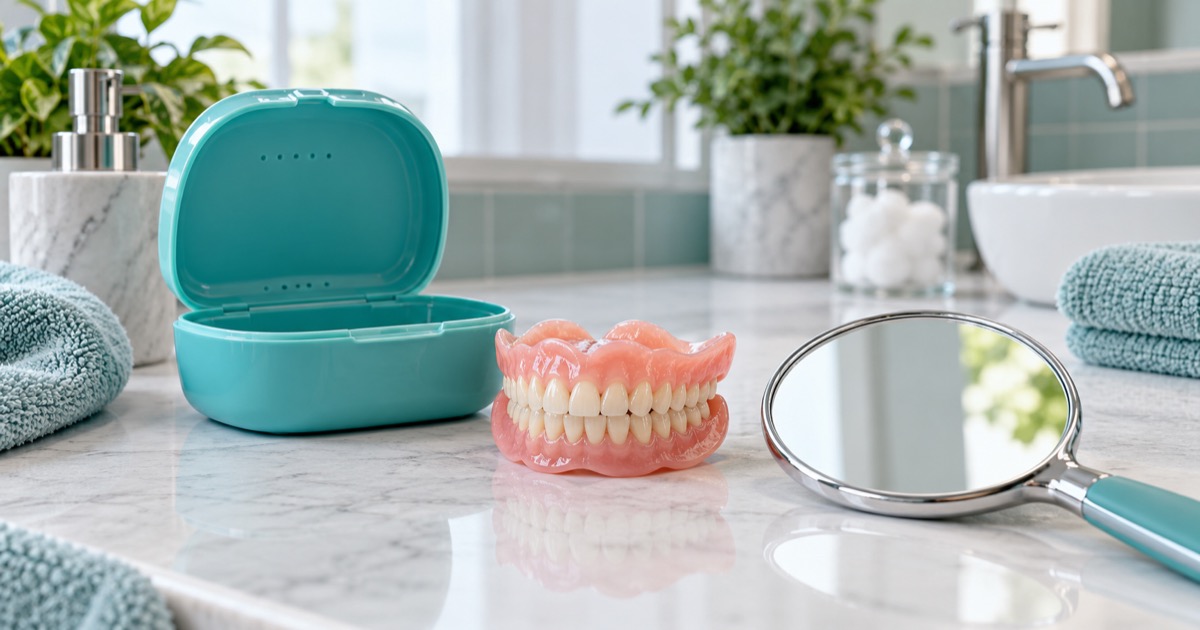
Loose removable dentures may need an adjustment, a reline or replacement. Learn what to check and when to see your dentist.
You are about to eat and you push your denture back into place with your tongue, as you have several times this week. Maybe you already choose foods to keep it from lifting. A denture that moves deserves a check of its fit and of the mouth that supports it. Adding more adhesive may hide the problem for a while, but it does not explain why things started to change.
Your mouth changes even if the denture stays the same
After tooth loss, the bone and tissues under the denture can change over time. The denture base keeps its shape and stops matching that surface. The artificial teeth, acrylic or other components can also wear or be damaged. The ACP links these changes to loss of retention, stability and support, and to tissue irritation (Tuminelli et al., 2015).
If you received an immediate denture on the same day as your extractions, there is an extra reason to expect adjustments: the tissues change while they heal. The ADA explains that such a denture may need relining or remaking once the area has healed. That does not mean every denture must be replaced right away; the plan should assess how yours is working (American Dental Association, n.d.).
Adjusting, relining and repairing solve different problems
An adjustment corrects a spot in the design that causes discomfort or affects how it works. When the inner surface no longer fits well, a reline may be considered to improve contact with the tissues. The ACP advises that a professional determine whether the denture can be reconditioned and discourages using home kits for this procedure (American College of Prosthodontists, n.d.).
A fracture or broken component requires a different evaluation. Repairing the piece does not guarantee that its fit and bite are correct; those also need checking afterwards. If the denture is badly worn or the design no longer suits your mouth, replacing it may be the better choice. The ACP notes that deciding between a reline, a base modification or a new denture requires examining retention, support, bite, appearance, speech and satisfaction (Tuminelli et al., 2015; American College of Prosthodontists, n.d.).
Ask what each option means in your plan and what problem it will solve. It may help to say: it lifts when I bite, it always rubs here or I can no longer speak comfortably. That description is more useful than asking for a new denture before the cause is known.
Adhesive has a limited role
A denture adhesive can provide extra retention in appropriate situations, but it does not by itself fix a poorly fitting denture. The ADA recommends considering a reline or replacement if the fit is poor and warns that using more adhesive does not replace that evaluation (American Dental Association, 2023).
If you need more and more product to get the same stability, ask for a check-up. ACP guidelines identify that increase as a reason to check the fit and recommend removing adhesive from the denture and your mouth every day. Don’t confuse denture adhesive with household glue, and don’t try to repair, file or reline the denture at home; ask for professional instructions (American College of Prosthodontists, n.d.; Felton et al., 2011).
Prepare a visit that addresses the cause
Bring the denture and note how long it has been moving, when it happens and which products you use. Mention any sore spots and any recent fall, repair or extraction. If it is an implant overdenture, also ask about the condition of its retention components (American College of Prosthodontists, n.d.).
There is no proven universal interval for relining or replacing every denture; the condition of the denture and the tissues guides the decision (Tuminelli et al., 2015). When you leave, look for a plan that identifies the cause, the proposed solution and the follow-up check. Eating and speaking without constantly repositioning your denture starts with evaluating the whole picture, not just the piece in your hand.
Want us to review your case? At The Special Teeth we see patients in English and Spanish, about 10 minutes from the San Ysidro border crossing, and we accept Aetna and MetLife PPO dental insurance. Learn more about dental implants in Tijuana or book your evaluation.
References
American College of Prosthodontists. (n.d.). Dentures FAQs. Retrieved October 9, 2026, from https://www.gotoapro.org/dentures-faq/
American Dental Association. (n.d.). Dentures. MouthHealthy. Retrieved October 9, 2026, from https://www.mouthhealthy.org/all-topics-a-z/dentures
American Dental Association. (2023). Denture care and maintenance. https://www.ada.org/resources/ada-library/oral-health-topics/dentures
Felton, D., Cooper, L., Duqum, I., Minsley, G., Guckes, A., Haug, S., Meredith, P., Solie, C., Avery, D., & Deal Chandler, N. (2011). Evidence-based guidelines for the care and maintenance of complete dentures: A publication of the American College of Prosthodontists. Journal of Prosthodontics, 20(S1), S1–S12. https://doi.org/10.1111/j.1532-849X.2010.00683.x
Tuminelli, F. J., Cooper, L. F., Campbell, S. D., Felton, D. A., Vickers, V. A., Masri, R., & Wei, A. (2015). Position statement: The frequency of denture replacement. American College of Prosthodontists. https://www.prosthodontics.org/about-acp/position-statement-the-frequency-of-denture-replacement/