 English

Horror dentists: how the dental chair became a scene of fear
From Jan Steen's quack tooth-puller to Marathon Man's Is it safe?: how the dentist became a villain, and why it was dentists who helped create anaesthesia.
In a 1960 scene, a man with toothache sits down in a dentist’s chair. The doctor smiles, takes out his forceps and blocks the exit. The patient ends up defending himself with a sharp instrument. The film is Roger Corman’s The Little Shop of Horrors, and it was shot in two days.
It was not the first time a dentist appeared as a threat, nor would it be the last. From the 17th-century Dutch market to Hollywood thrillers, the person who works inside our mouth has again and again been the villain. There are reasons for that, and a paradox: it was dentists who helped make surgery stop hurting.
The market charlatan
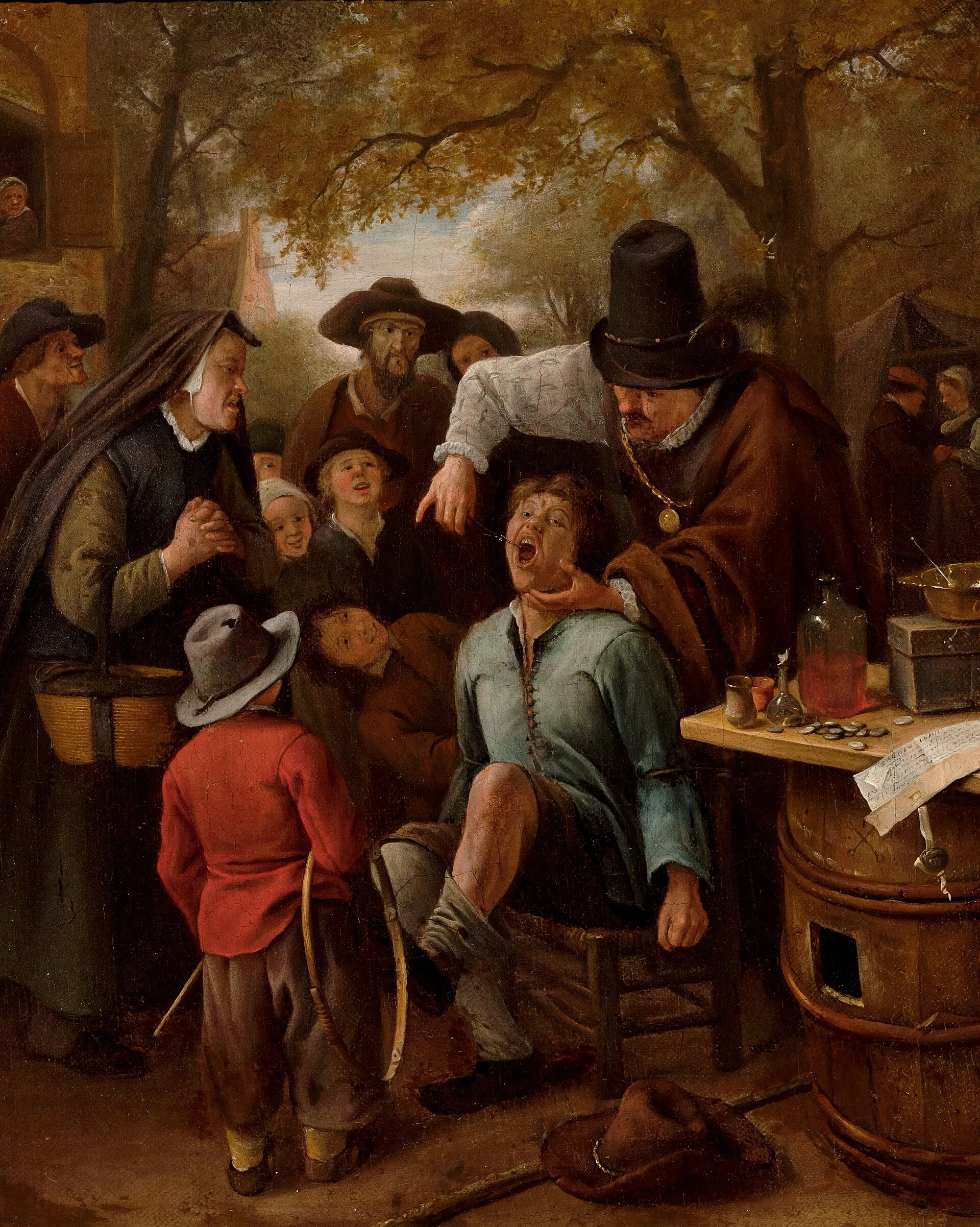
Before dental offices existed, pulling a tooth was a public spectacle. In the 17th century, when Dutch painters began depicting everyday life, the tooth-puller became a popular subject. Gerrit van Honthorst, Gerrit Dou and Jan Steen all painted him.
In Jan Steen’s The Tooth-Puller of 1651, a boy clenches his fist while a man grips his tooth with pincers in the middle of a market. According to the Mauritshuis, the museum that holds the work, the figure is a quack: he wears old-fashioned clothes, a pompous chain and medal, and displays a fake certificate with a large seal. Almost everyone present is laughing. Only an old woman looks worried.
Such scenes reflected something real. Many tooth-pullers had no training, broke roots or pulled the wrong tooth, and patients knew it but had no alternative. In another work by Steen, an accomplice uses the distraction to rob the patient.
The fashionable dentist
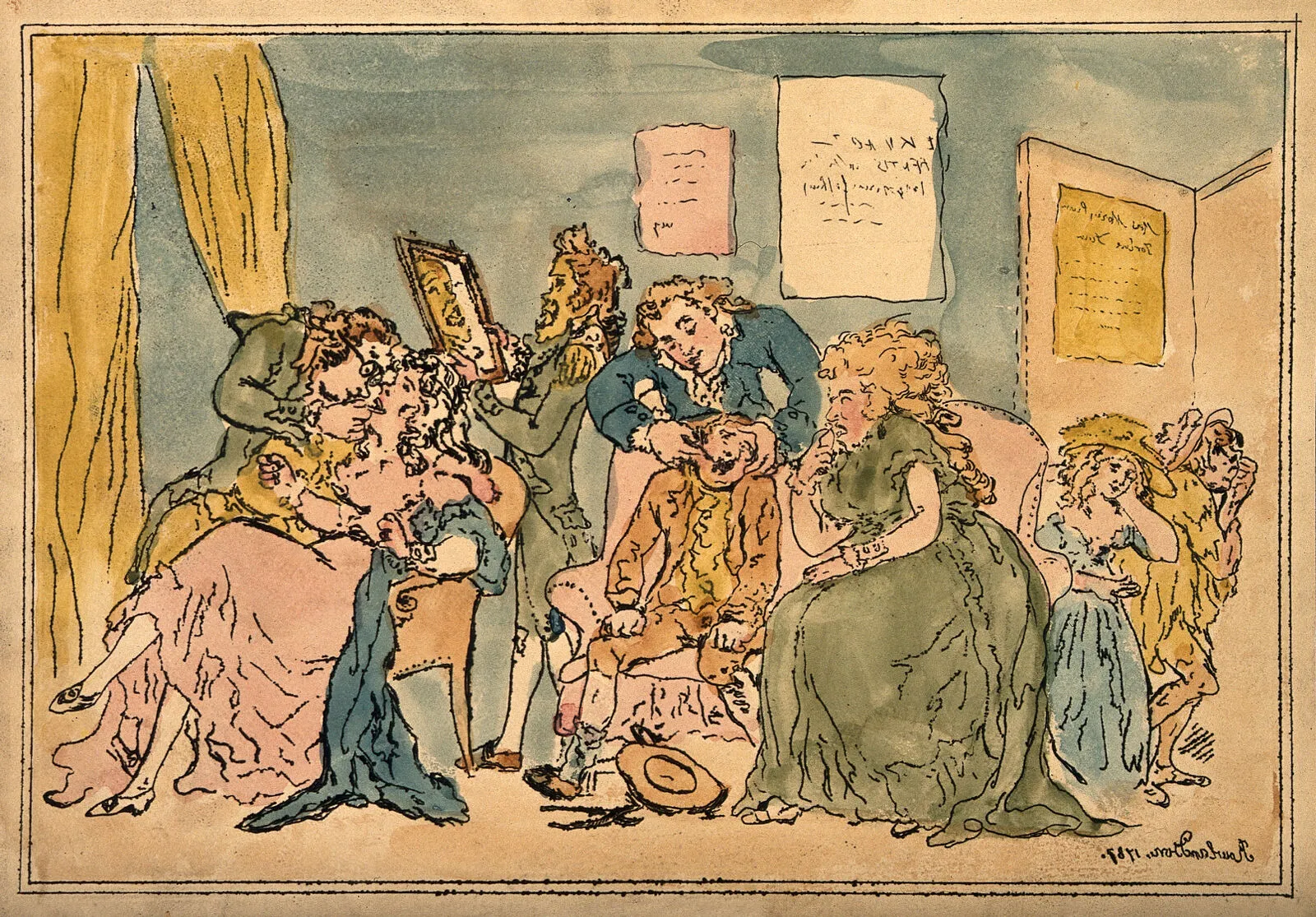
In the 18th century, satire changed its target. The English caricaturist Thomas Rowlandson mocked fashionable dentists who transplanted teeth from poor people into wealthy clients. It was no longer the fairground quack but the unscrupulous professional.
The first dark dentists of literature and film
In 1899 the American novelist Frank Norris published McTeague. Its protagonist is a San Francisco dentist with no degree or licence. When he is reported, he loses his practice, falls into poverty and ends up beating his wife to death. In 1924 Erich von Stroheim adapted it for the screen as Greed.
McTeague is not a horror monster, but he is one of the first dentists to lead a crime story. One of the first famous dentists of sound cinema was, by contrast, a comic one: W. C. Fields in the 1932 short The Dentist.
The sadistic dentist of The Little Shop of Horrors arrived in 1960. In that film a young Jack Nicholson plays Wilbur Force, a patient who asks to have his teeth worked on without anaesthetic because he enjoys the pain. In the 1986 musical, Steve Martin made the dentist an even more famous character.
“Is it safe?”
The most memorable scene came in 1976 with Marathon Man. Laurence Olivier plays Christian Szell, a Nazi physician and dentist hiding in Uruguay. To interrogate Dustin Hoffman’s character, he calmly arranges his instruments and repeats a single question: “Is it safe?” There is no blood on screen and yet it became one of cinema’s most harrowing scenes. Olivier was nominated for an Oscar.
In 1996 Brian Yuzna directed The Dentist, with Corbin Bernsen as a Los Angeles dentist who turns killer after discovering his wife’s affair. The film had a sequel.
Why does the fear work?
Cinema did not invent fear of the dentist; it exploited it. A systematic review published in 2021 estimated that around 13.8% of adults have dental fear and that about 11.2% have high dental fear.
The dental-office scene brings together almost everything that makes a horror story work: the patient is lying back, mouth open, unable to speak and looking at metal instruments they do not understand. The other person is in control and very close to their face. And for centuries, that moment really did hurt.
The twist: the dentists who ended the pain
The paradox is that surgical anaesthesia has roots in dentistry. In December 1844, Hartford dentist Horace Wells attended a laughing-gas demonstration and the next day had one of his own teeth pulled under nitrous oxide. His public demonstration in Boston in 1845 failed.
On 16 October 1846 another dentist, William Morton, administered ether at Massachusetts General Hospital during the first recorded anaesthetised surgery there. That day is often considered the start of modern anaesthesia.
What is known and what is still debated
Documented:
- 17th-century Dutch painters portrayed tooth-pullers as charlatans.
- McTeague (1899), The Little Shop of Horrors (1960), Marathon Man (1976) and The Dentist (1996) feature criminal or menacing dentists.
- The dentists Horace Wells and William Morton were pioneers of anaesthesia in the 1840s.
Still debated:
- Who was the “first” villainous dentist: it depends on whether painting, satire, the novel or film is counted, and on how broadly “villain” is defined.
- How much these films influence real dental fear. The idea is common, but fear is usually linked more to previous personal experiences.
From the quack’s chair to today’s
Dental-office horror worked because the patient did not know what would happen and could not say anything. That is why today so much weight is given to explaining each step, agreeing on signals to pause and using the right anaesthesia. If an extraction makes you nervous, we explain how it is done today in The dental key, and the story of another literary character obsessed with teeth is in Berenice.
Sources
- Hektoen International — The tooth-pullers
- Mauritshuis — Jan Steen, The Tooth-Puller (1651), inv. 165
- Wikipedia — McTeague (Frank Norris, 1899)
- AFI Catalog — The Little Shop of Horrors (1960)
- CrimeReads — Still not safe: the 50th anniversary of Marathon Man
- Wikipedia — The Dentist (1996)
- Hartford Stage — Horace Wells and William Morton
- Estimated prevalence of dental fear in adults: a systematic review and meta-analysis (2021)