 English

Broken Tooth, Crown or Denture? What to Do Until You Get Care
A broken tooth, crown or denture: temporary steps you can take and when to seek professional care.
You hear a crack while eating and find a small piece in your mouth. The first question can be as simple as it is unsettling: “Did my tooth break, or did something that was placed come off?” Before trying a home repair, it is worth keeping the piece and explaining to the dentist what happened. A tooth fragment, a loose crown and a broken denture need different evaluations.
First, recognize when you need help right away
If there is a significant injury to the face or jaw, heavy bleeding that won’t stop, or severe swelling with difficulty breathing, seek emergency care immediately. Those signs require more than waiting for an appointment to repair the piece (National Health Service, n.d.).
Also ask for a prompt dental evaluation if the pain is severe or swelling appears with fever. NHS guidance material lists broken teeth, dislodged crowns and damaged dentures among the problems that need assessment; the priority depends on your symptoms and situation (NHS North East and North Cumbria Integrated Care Board, n.d.).
When a piece of tooth breaks off
If you find the fragment, the NHS recommends placing it in milk or saliva in a container and taking it to the dentist. Don’t keep it loose in your mouth. In some cases it can be used to repair the tooth; other options include a filling, a crown or further care if the damage is deeper. The exam determines what is appropriate (National Health Service, 2025a).
Explain whether there was a blow, what you were doing and when it happened. You don’t need to identify the tissue or estimate the size of the fracture to ask for help.
A whole tooth knocked out by a blow is a different situation: ask for immediate dental care and say clearly that the entire tooth came out. The NHS emergency guidance distinguishes that problem from a small fracture (National Health Service, n.d.). Don’t treat the instructions for a fragment as complete care for a knocked-out tooth.
When a crown comes off
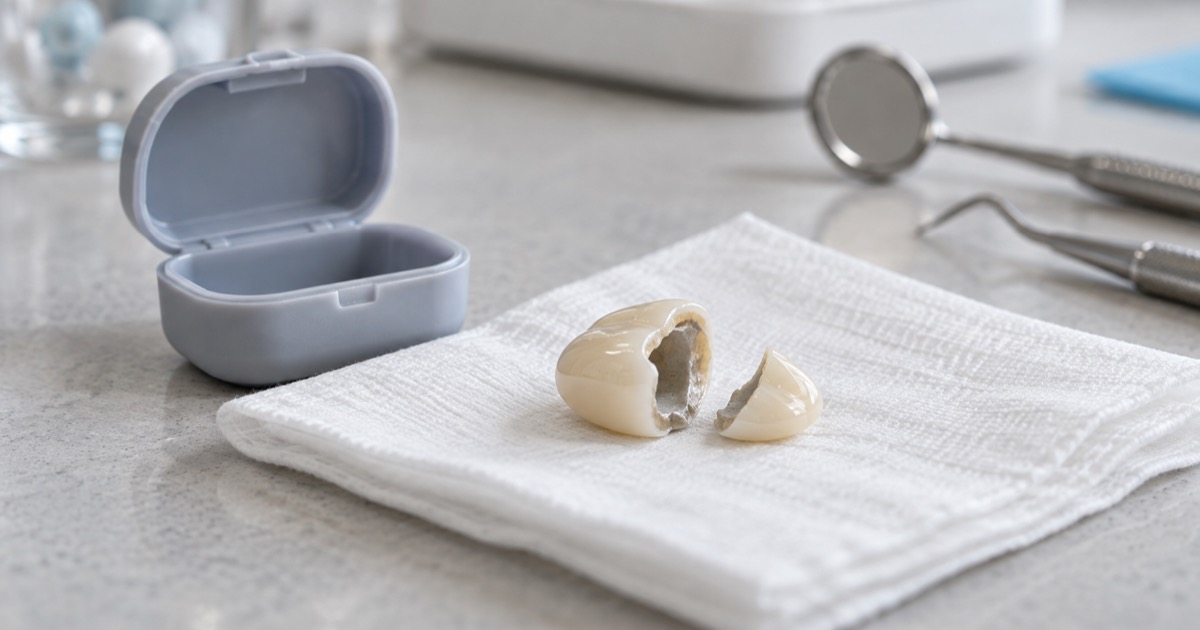
Keep the crown in a safe container and mention whether a piece of tooth also came out. Ask for instructions before trying to put it back; don’t assume it can be re-cemented without checking the fit and the tooth underneath.
Avoid sticking it back with household adhesives. A self-care guide hosted by NHS Scotland specifically warns against using superglue on a loose crown (Westfield Surgery, n.d.). Bring the crown to your appointment and ask whether it can be kept or whether the problem needs another solution.
When a removable denture breaks
Collect all the pieces you can find and bring both the denture and the fragments. The NHS recommends doing so so the professional can assess whether it can be repaired. Having all the pieces does not guarantee that a repair is appropriate or remove the need to check how it works (National Health Service, 2025b).
Don’t glue the parts together or try to modify the appliance yourself. The Health Education England professional fact sheet advises against gluing the fragments and recommends a dental evaluation. If the appliance causes an injury, stop wearing it and ask for instructions (Health Education England, n.d.).
How to prepare the call and the appointment
Describe what broke, when it happened and whether there is pain, bleeding, swelling or difficulty eating. A photo can help explain what is visible, but ask what additional information the team needs.
When you leave the appointment, clarify what was done, whether the solution is temporary and when you should come back. Resolving the episode includes understanding the aftercare. If the denture was already loose before it broke, also read the article on denture fit; if extracting a tooth is proposed, go back to the questions about saving the tooth.
Want us to review your case? At The Special Teeth we see patients in English and Spanish, about 10 minutes from the San Ysidro border crossing, and we accept Aetna and MetLife PPO dental insurance. Learn more about crowns and veneers or book your evaluation.
References
Health Education England. (n.d.). Fractured dental appliances (including orthodontic appliances) [Fact sheet]. Retrieved October 9, 2026, from https://london.wtepharmacy.nhs.uk/dyn/_assets/_folder4/dental-factsheets-2022/dental_factsheets_fractured_dental_appliances.pdf
National Health Service. (n.d.). How to find an NHS dentist in an emergency. Retrieved October 9, 2026, from https://www.nhs.uk/nhs-services/dentists/how-to-find-an-nhs-dentist-in-an-emergency/
National Health Service. (2025a). Chipped, broken or cracked tooth. https://www.nhs.uk/conditions/chipped-broken-or-cracked-tooth/
National Health Service. (2025b). Dentures (false teeth). https://www.nhs.uk/tests-and-treatments/dentures/
NHS North East and North Cumbria Integrated Care Board. (n.d.). Urgent dental care toolkit. Retrieved October 9, 2026, from https://northeastnorthcumbria.nhs.uk/media/imykhqs5/urgent-dental-care-toolkit.pdf
Westfield Surgery. (n.d.). Managing dental problems at home [Brochure]. NHS Scotland. Retrieved October 9, 2026, from https://www.westfieldsurgery.scot.nhs.uk/website/S87729/files/dental%20self%20help.pdf