 English

Dental Implant or Bridge: How to Choose When You Are Missing a Tooth
Implant or bridge: differences, clinical factors, care and the questions to ask before replacing a missing tooth.
Imagine you receive two proposals to replace a tooth: one mentions an implant and the other a bridge. In the drawings, both leave you with a complete smile. The important difference appears when you look at what happens beneath that image: where the replacement is supported and what changes your mouth needs.
Choosing between an implant and a dental bridge starts with understanding those supports. Then you compare the condition of the neighboring teeth, the bone, the treatment stages and the care involved.
What supports each option
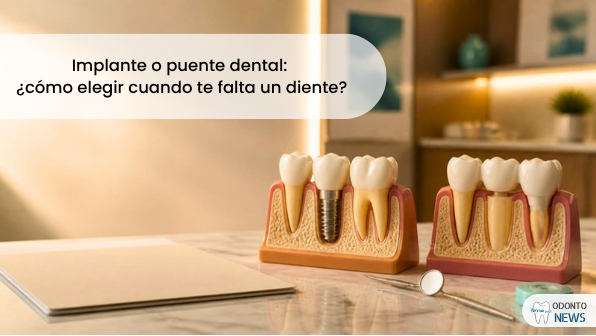
A bridge replaces the missing tooth with an artificial tooth attached to the teeth around it, which act as supports. If it is fixed, only the dentist can remove it. Because it depends on those supports, keeping the supporting teeth healthy is part of the treatment’s success (American Dental Association, n.d.).
For a single missing tooth, the implant is placed in the bone and supports a crown, which is the visible part of the replacement. The American Academy of Periodontology sums it up this way: an implant replaces the tooth without sacrificing the health of the neighboring teeth, while a conventional bridge requires grinding them down so they can hold the replacement (American Academy of Periodontology, n.d.-b).
Ask the dentist to show you the proposed design. “Bridge” can describe different restorations; it matters how many teeth will be involved and what preparation they will receive.
The neighboring teeth change the conversation
In a conventional bridge, the supporting teeth are reduced to receive crowns. A leaflet from Leeds Teaching Hospitals warns that this preparation can damage the teeth holding the bridge and affect their nerve (Bhakta, 2025).
Consider two situations: intact neighboring teeth, and teeth that already have crowns or large fillings. The same leaflet notes that when the supporting teeth already have crowns or large restorations, a conventional bridge is often advised (Bhakta, 2025). An implant can avoid preparing the neighbors (American Academy of Periodontology, n.d.-b). An evaluation of the whole picture determines which option is appropriate.
That is why it is worth asking what will be preserved and what will be modified with each proposal.
Some bridges require less preparation
A resin-bonded (Maryland) bridge is bonded to a neighboring tooth and requires little or no grinding. Its most common complication is that the cement fails and it comes loose; according to Leeds, this is generally solved by cleaning and re-bonding it. That is why its design and case selection matter (Bhakta, 2025).
Ask whether that alternative makes sense for the gap you want to replace. That way you can compare a specific proposal instead of assuming every bridge involves the same work on your teeth.
What should be evaluated before placing an implant
The American Academy of Periodontology describes the ideal candidate as someone with good general and oral health, enough bone to support the implant and healthy gums, free of periodontal disease. The treatment plan is tailored to each person (American Academy of Periodontology, n.d.-a).
There is also a stage in which the implant integrates with the bone, followed by the restoration; some phases can be combined when conditions allow. Ask them to explain what will be temporary, what will be final and how the visits will be organized (American Academy of Periodontology, n.d.-b).
What research can tell us
A cohort study published in 2015 compared three-unit bridges and implant-supported crowns with up to fifteen years of follow-up. It found comparable survival for back-tooth replacements and higher survival of implant crowns in the front of the mouth (Walton, 2015).
It was an observational comparison from a specialist practice with selected patients; it does not prove that implants are better for everyone. Its results are not an individual guarantee of how long a restoration will last either (Walton, 2015).
Maintenance is part of the choice
Implants require consistent home care and regular visits; brushing and flossing are still necessary (American Academy of Periodontology, n.d.-a). With a bridge, you also need to clean under the replacement tooth by threading floss along the gum; ask to be shown how (Bhakta, 2025).
Before deciding, ask for a complete estimate and these questions:
- Why do you recommend this design for my mouth?
- What changes will the supporting teeth need?
- What stages and check-ups are included?
- How will a repair or complication be handled?
The choice should let you understand what you will receive, how you will care for it and why it fits your situation. To complete the comparison, review what an implant estimate should include and how its stages are planned.
Want us to review your case? At The Special Teeth we see patients in English and Spanish, about 10 minutes from the San Ysidro border crossing, and we accept Aetna and MetLife PPO dental insurance. Learn more about dental implants in Tijuana or book your evaluation.
References
American Academy of Periodontology. (n.d.-a). Dental implant procedures. Retrieved October 9, 2026, from https://www.perio.org/for-patients/periodontal-treatments-and-procedures/dental-implant-procedures/
American Academy of Periodontology. (n.d.-b). Single tooth dental implants. Retrieved October 9, 2026, from https://www.perio.org/for-patients/periodontal-treatments-and-procedures/dental-implant-procedures/single-tooth-dental-implants/
American Dental Association. (n.d.). Bridges. MouthHealthy. Retrieved October 9, 2026, from https://www.mouthhealthy.org/all-topics-a-z/bridges
Bhakta, S. (2025, July 31). Bridges (Leaflet LN002350). Leeds Teaching Hospitals NHS Trust. https://www.leedsth.nhs.uk/patients/resources/bridges/
Walton, T. R. (2015). An up-to-15-year comparison of the survival and complication burden of three-unit tooth-supported fixed dental prostheses and implant-supported single crowns. The International Journal of Oral & Maxillofacial Implants, 30(4), 851–861. https://doi.org/10.11607/jomi.4220
Keep reading
- How Much Does a Dental Implant Cost? What Your Estimate Should Include
- What Happens If You Leave a Missing Tooth Untreated?
- How Long Do Dental Implants Take? The Stages to Know Before You Start
Educational information. A professional evaluation determines the diagnosis and the appropriate options for each patient.