 English

Do All Wisdom Teeth Need to Be Removed?
Not every wisdom tooth needs extraction. Learn which factors are evaluated and when it makes sense to request a dental assessment.
You leave a check-up with an X-ray and hear that you have an impacted wisdom tooth. Maybe you remember that your friends had all four removed and assume the same applies to you. Before scheduling surgery, it helps to understand what the dentist found: the tooth’s position is one part of the decision, but it does not tell the whole story.
Impacted does not automatically mean diseased
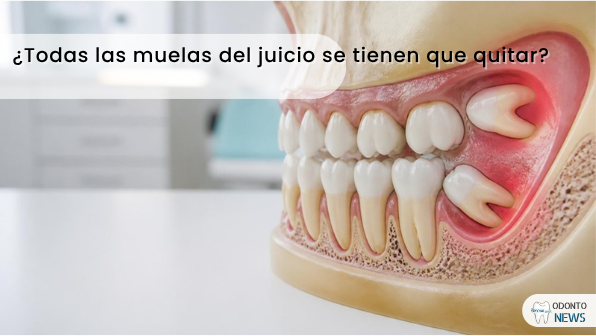
Third molars are the last teeth to come in. An impacted wisdom tooth is one that stays trapped in the bone or under the gum. The American Dental Association notes that when wisdom teeth come in properly and are healthy, they can help with chewing. Before deciding anything, the dentist examines the mouth and takes an X-ray (American Dental Association, n.d.).
Having wisdom teeth without pain does not mean they are healthy either. Among the reasons for removing them, the same association lists decay that cannot be repaired, gum disease, damage to neighboring teeth, infections and cysts, and advises continuing to monitor the ones you keep because they can cause problems later. So deciding when to remove wisdom teeth requires clinical findings, not just asking whether they hurt today (American Dental Association, n.d.).
When there is a specific problem
Extraction may be indicated for decay that cannot be restored, certain infections, damage to nearby teeth or lesions such as a cyst. The professional should identify the problem and explain why removing the tooth offers a benefit in your situation. The NICE guidance from the UK health system lists these circumstances and calls for reserving surgery for cases with demonstrated disease, rather than preventively extracting a healthy impacted tooth. It adds that plaque buildup alone is not enough reason to operate (National Institute for Health and Care Excellence, 2000).
A gum infection around a partially erupted molar is called pericoronitis. NICE notes that a first episode, unless it is especially severe, is not by itself a reason for surgery; from the second episode on, extraction is considered appropriate. It is a British guideline from 2000, not a Mexican standard that replaces your evaluation. Its value is showing why severity and recurrence matter (National Institute for Health and Care Excellence, 2000).
What we know about preventive removal
The 2020 Cochrane review did not find enough evidence to conclude whether it is better to remove or keep impacted third molars that cause no symptoms and show no disease. It found only two studies, with 493 participants in total, and rated the certainty of the evidence as low or very low. That expresses uncertainty: it does not prove that keeping them is always safe or that surgery is always better (Ghaeminia et al., 2020).
The review found a possible association between keeping these teeth and long-term periodontal disease of the second molar, but the evidence was very uncertain. It also did not find that removing them has a clinically relevant effect on crowding. The authors conclude that the decision should be made between the patient and the professional, considering the findings, clinical judgment and your preferences (Ghaeminia et al., 2020).
Monitoring needs a plan too
If the recommendation is to keep them, ask which areas you should clean, which changes you should report and when your next check-up should be. Cochrane advises regular clinical check-ups when you decide to keep these teeth; the interval should be agreed for your case (Ghaeminia et al., 2020).
If surgery is proposed, bring your medical history and medications and ask for an explanation of the risks, alternatives and follow-up. Write down three questions: what problem does this tooth have, what could happen if we wait, and what changes if we remove it now? Ask to be shown the findings on the image in plain language.
You may leave the appointment with a recommendation for extraction or for monitoring. What matters is that you understand the reason and have a defined next step. An informed decision starts when you can explain what the treatment is meant to solve, without relying on what happened with someone else’s teeth.
Want us to review your case? At The Special Teeth we see patients in English and Spanish, about 10 minutes from the San Ysidro border crossing, and we accept Aetna and MetLife PPO dental insurance. Learn more about our treatments and reference prices or book your evaluation.
References
American Dental Association. (n.d.). Wisdom teeth. MouthHealthy. Retrieved October 9, 2026, from https://www.mouthhealthy.org/all-topics-a-z/wisdom-teeth
Ghaeminia, H., Nienhuijs, M. E. L., Toedtling, V., Perry, J., Tummers, M., Hoppenreijs, T. J. M., Van der Sanden, W. J. M., & Mettes, T. G. (2020). Surgical removal versus retention for the management of asymptomatic disease-free impacted wisdom teeth. Cochrane Database of Systematic Reviews, (5), Article CD003879. https://doi.org/10.1002/14651858.CD003879.pub5
National Institute for Health and Care Excellence. (2000). Guidance on the extraction of wisdom teeth (Technology Appraisal Guidance TA1). https://www.nice.org.uk/guidance/ta1/chapter/1-Recommendations
Keep reading
- What Can You Eat After Wisdom Tooth Removal?
- Wisdom Teeth Recovery: What to Expect and When to Call Your Dentist
Educational information. A professional evaluation determines the diagnosis and the appropriate options for each patient.