 English

What Happens If You Leave a Missing Tooth Untreated?
A missing tooth can affect your bite and oral function. Learn which factors to weigh before deciding whether to replace it.
The back molar is gone, but it barely shows when you smile. Weeks go by and a reasonable question comes up: “If I can eat and it doesn’t hurt, do I need to do anything?” The consequences of losing a tooth depend on which tooth it is, your bite and the health of the rest of your mouth.
A gap can affect more than how you look in photos
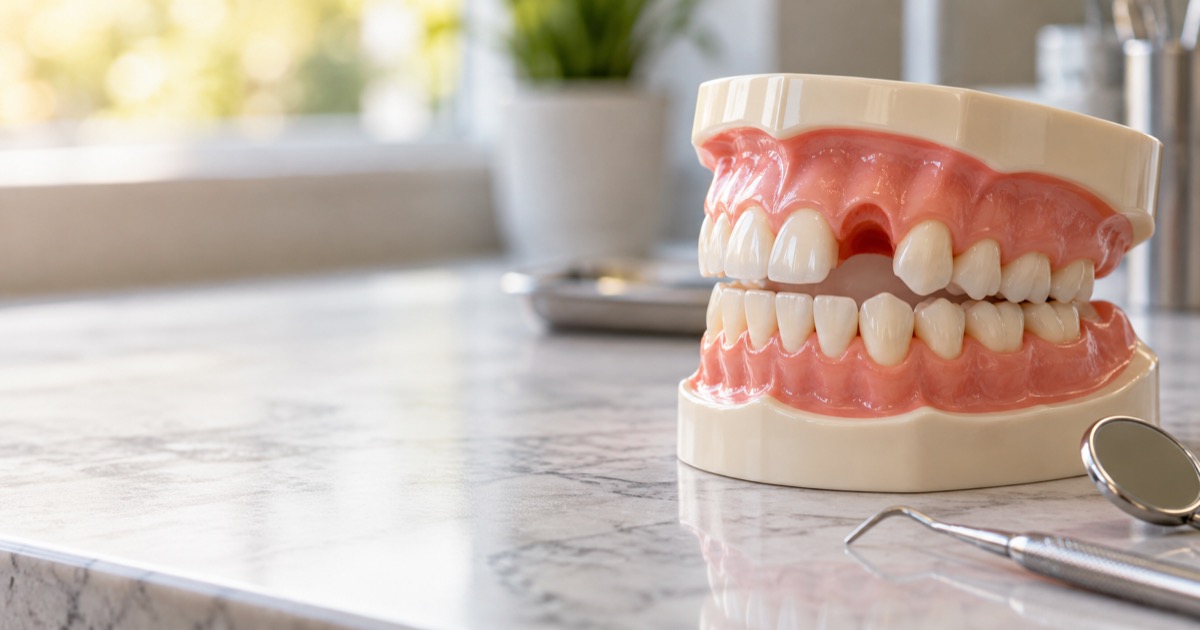
A missing tooth can change the way you chew and, depending on the location or size of the gap, affect your speech. The remaining teeth can also shift, and bone can be lost around the gap. The American Dental Association describes these possibilities, though that does not mean everyone will have the same problems (American Dental Association, n.d.-b).
At your appointment, mention whether you avoid certain foods, chew on only one side or notice that the way your teeth meet has changed. Being able to describe your experience helps focus the evaluation on what you need to solve.
Teeth can change position
When a molar loses contact with the one opposite it, it can drift into that space. This movement is called over-eruption. Tilting can also occur, and the size of the changes varies (Wang et al., 2022).
A 2022 observational study analyzed 68 molars without an opposing tooth in 59 patients and documented movement in the months before they were restored: on average, less than half a millimeter of over-eruption and slight tilting over about nine months. The participants had periodontitis, which limits applying the results to anyone with a missing molar. The study supports checking the gap and the bite; it does not show that everyone will experience significant shifting (Wang et al., 2022).
The bone also changes after an extraction
The socket where the root was heals, and the shape of the bony ridge can change. A systematic review published in 2021 gathered 28 articles on healing without socket preservation procedures and found reductions in width and height that varied by tooth type and measurement method; width loss was the greatest in every group (Couso-Queiruga et al., 2021).
These are results for study groups, not an exact prediction for your mouth. If you want an implant later, the evaluation will need to consider the bone available at that time. Having waited does not, by itself, mean you need a graft or can no longer have an implant (Couso-Queiruga et al., 2021).
Does every molar always need to be replaced?
There is an approach called the shortened dental arch, which preserves or restores a functional set of teeth without necessarily replacing every molar. A fifteen-year trial compared it with removable partial dentures in adults over 35 who were missing the molars in one arch and still had at least the canine and one premolar on each side (Walter et al., 2021).
In the shortened-arch group, the teeth ended at the second premolar, kept or replaced with a fixed prosthesis, and there were regular check-ups. In both groups, changes and complications over time were common: at fifteen years they affected most patients, and there were no statistically significant differences between the two options. This allows individualized alternatives to be discussed, but it does not prove universal equivalence or justify skipping follow-up (Walter et al., 2021).
How to weigh the options without skipping questions
When replacing a tooth is recommended, bridges, removable prostheses or implants may be considered depending on the case (American Dental Association, n.d.-b). An implant involves surgical placement, several months of integration with the bone and the final restoration. The ADA notes that general health matters more than age: chronic conditions such as diabetes can interfere with healing, and smoking slows it down (American Dental Association, n.d.-a).
Ask them to explain the condition of the gap, which teeth take part in your bite and what goal each alternative would have. If you prefer to wait, clarify which check-ups are proposed and which changes would warrant coming back sooner.
Bring the approximate time since the tooth was lost, the reason for the extraction if you know it and any previous imaging you have. Ask about benefits, risks, maintenance, stages and costs before choosing.
The decision may be to replace the tooth or to keep the gap under a care plan. What matters is understanding why that option fits your situation and how it will be monitored. A gap that barely shows still deserves a clear conversation.
Want us to review your case? At The Special Teeth we see patients in English and Spanish, about 10 minutes from the San Ysidro border crossing, and we accept Aetna and MetLife PPO dental insurance. Learn more about dental implants in Tijuana or book your evaluation.
References
American Dental Association. (n.d.-a). Implants. MouthHealthy. Retrieved October 9, 2026, from https://www.mouthhealthy.org/all-topics-a-z/implants
American Dental Association. (n.d.-b). Missing teeth. MouthHealthy. Retrieved October 9, 2026, from https://www.mouthhealthy.org/all-topics-a-z/missing-teeth
Couso-Queiruga, E., Stuhr, S., Tattan, M., Chambrone, L., & Avila-Ortiz, G. (2021). Post-extraction dimensional changes: A systematic review and meta-analysis. Journal of Clinical Periodontology, 48(1), 127–145. https://doi.org/10.1111/jcpe.13390
Walter, M. H., Marré, B., Dreyhaupt, J., Heydecke, G., Rauch, A., Mundt, T., Hannak, W., Kohal, R. J., Kern, M., Nothdurft, F., Hartmann, S., Böning, K., Boldt, J., Stark, H., Edelhoff, D., Wöstmann, B., Wolfart, S., Jahn, F., & Luthardt, R. G. (2021). Rehabilitation of shortened dental arches: A fifteen-year randomised trial. Journal of Oral Rehabilitation, 48(6), 738–744. https://doi.org/10.1111/joor.13167
Wang, A., Cao, J., Zhang, H., Zhang, B., Yang, G., Hu, W., & Chung, K.-H. (2022). Three-dimensional position changes of unopposed molars before implant rehabilitation: A short-term retrospective cohort analysis. BMC Oral Health, 22, Article 562. https://doi.org/10.1186/s12903-022-02619-y
Keep reading
- Dental Implant or Bridge: How to Choose When You Are Missing a Tooth
- Removable Dentures vs Fixed Teeth on Implants: The Differences That Matter
- Not Enough Bone for a Dental Implant? Options That Can Be Evaluated
Educational information. A professional evaluation determines the diagnosis and the appropriate options for each patient.