 English

Not Enough Bone for a Dental Implant? Options That Can Be Evaluated
Low bone volume does not always rule out a dental implant. Learn which studies and alternatives a specialist may consider.
You arrive at your appointment hoping to replace a tooth and hear: “There isn’t enough bone in this area.” It’s easy to assume that’s the end of the plan. Before jumping to conclusions, it helps to turn that sentence into specific questions: where is the limitation, how much does it affect the proposal and which alternatives are worth evaluating?
Location changes the possibilities
The bone that would surround the implant must allow it to be placed in an appropriate position. The American Academy of Periodontology (AAP) explains that defects in the upper or lower jaw, caused by gum disease, wearing dentures, developmental problems or injuries, can leave insufficient bone. In those cases the area can be rebuilt with graft material (American Academy of Periodontology, n.d.-a).
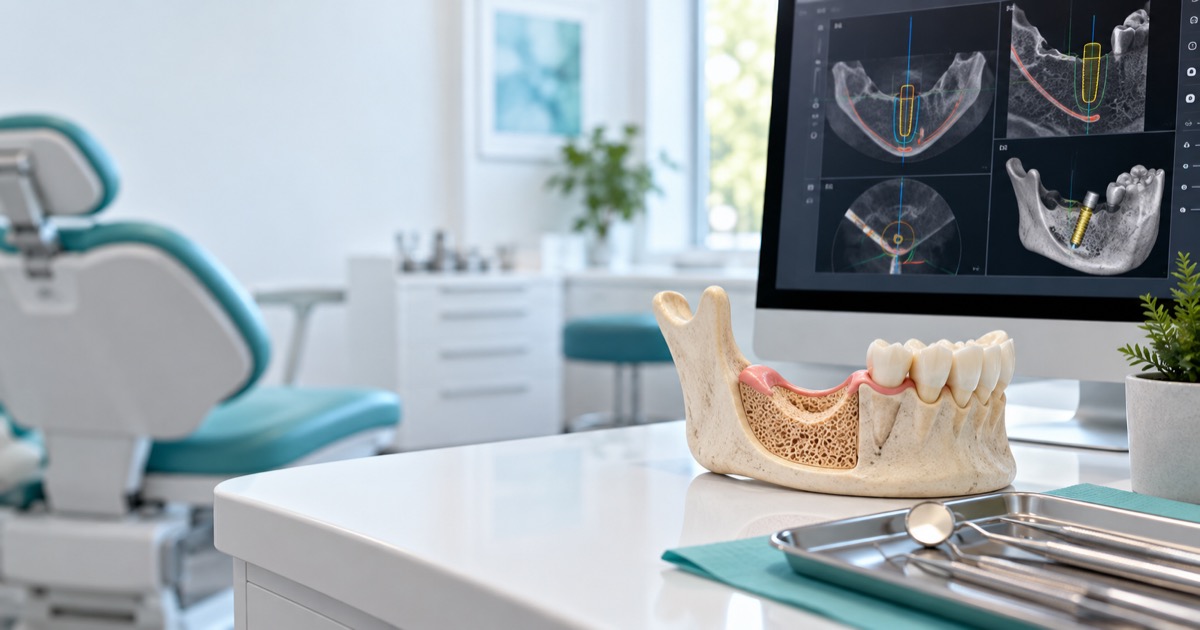
To understand “not enough bone,” ask whether the limitation is in height, width or both. The relationship with neighboring structures, such as nerves or the maxillary sinus, also matters. The 2026 ADA/AAOMR recommendations support three-dimensional evaluation with cone-beam computed tomography, known as CBCT, to plan implants and bone augmentation procedures (Benavides et al., 2026).
Imaging is chosen after reviewing your medical history, examining you and considering previous images. A photo of your smile can guide a conversation, but it does not replace that evaluation of bone volume (Benavides et al., 2026).
Bone grafting: creating conditions for placement
A graft aims to increase the available bone. The material may come from the patient, from human or animal sources, or be synthetic; it acts as a scaffold for bone to form. Some techniques also use a membrane to protect the area. Ask which material is proposed and why (Cambridge University Hospitals NHS Foundation Trust, 2024).
Depending on its extent and the technique, the graft may be done together with the implant or require an earlier healing stage; when the graft is extensive, Cambridge University Hospitals performs it at least four months before the implant (Cambridge University Hospitals NHS Foundation Trust, 2024). The AAP indicates that, in general, four to twelve months are allowed for bone to form, although in some cases the implant is placed in the same surgery (American Academy of Periodontology, n.d.-a). The result must be checked before moving forward: infection, graft exposure or insufficient bone formation can occur, and graft failure is more likely in people who smoke (Cambridge University Hospitals NHS Foundation Trust, 2024).
Understanding these possibilities lets you ask something more useful than “does the graft work?”: “What do you need to confirm in my case before continuing with the implant?”
Sinus lift: an option for a specific area
In the back of the upper jaw, the closeness of the maxillary sinus can limit the available space. A sinus lift raises its floor and encourages bone formation so implants can be placed. It is reserved for situations where the anatomy and the plan justify it; it is not a routine stage of every implant (American Academy of Periodontology, n.d.-b).
The AAP describes that it is usual to wait four to twelve months for bone to form before placing implants, although in some cases the implant is placed during the same sinus lift; afterwards, another healing period is always needed. The team should explain which approach is planned and what conditions the area needs to meet (American Academy of Periodontology, n.d.-b).
Can a short implant avoid additional surgery?
It is an alternative that can be considered in selected situations. A 2023 systematic review gathered five randomized trials with at least five years of follow-up, comparing short implants with standard implants combined with a sinus lift in the back of an upper jaw with little bone (Mester et al., 2023).
The difference in survival did not reach statistical significance. The authors consider short implants a possible alternative but note that more long-term studies are needed. These results do not show universal equivalence or allow choosing implant size without assessing the anatomy and the planned restoration (Mester et al., 2023).
Choose a plan you can understand and follow
If an implant is not a good fit, a bridge, another removable prosthesis design or even no treatment can also be considered, depending on the condition of your mouth. Tell the team about your medical conditions and medications: Guy’s and St Thomas’ Hospital warns that some conditions change the recommendations and that smoking increases the risk that the implant will not bond to the bone (Guy’s and St Thomas’ NHS Foundation Trust, 2024).
Ask for a plan that identifies the goal of each procedure, the alternatives, the proposed material, the stages and the check-ups. If you are traveling for treatment, clarify how many visits might be needed and who would handle a complication.
Hearing “not enough bone” stops being a label when you can point to the area, understand the proposal and explain why you are considering it. That is a good starting point for deciding, without promises of an identical solution for everyone.
Want us to review your case? At The Special Teeth we see patients in English and Spanish, about 10 minutes from the San Ysidro border crossing, and we accept Aetna and MetLife PPO dental insurance. Learn more about dental implants in Tijuana or book your evaluation.
References
American Academy of Periodontology. (n.d.-a). Ridge modification. Retrieved October 9, 2026, from https://www.perio.org/for-patients/periodontal-treatments-and-procedures/dental-implant-procedures/ridge-modification/
American Academy of Periodontology. (n.d.-b). Sinus augmentation. Retrieved October 9, 2026, from https://www.perio.org/for-patients/periodontal-treatments-and-procedures/dental-implant-procedures/sinus-augmentation/
Benavides, E., Krecioch, J. R., Allareddy, T., Buchanan, A., Keels, M. A., Mascarenhas, A. K., Duong, M. L., O’Brien, K. K., Ziegler, K. M., Lipman, R. D., Connolly, R. T., Cevidanes, L., Cordell, K., Elangovan, S., Fouad, A. F., González-Cabezas, C., Huja, S. S., Kademani, D., Khan, A., . . . Yepes, J. (2026). American Dental Association and American Academy of Oral and Maxillofacial Radiology patient selection for dental radiography and cone-beam computed tomography: Clinical recommendations. The Journal of the American Dental Association, 157(1), 20–35.e5. https://doi.org/10.1016/j.adaj.2025.10.013
Cambridge University Hospitals NHS Foundation Trust. (2024, July 15). Bone grafting for dental implants (Document 101926, version 3). https://www.cuh.nhs.uk/patient-information/bone-grafting-for-dental-implants/
Guy’s and St Thomas’ NHS Foundation Trust. (2024). Dental implants: Overview. https://www.guysandstthomas.nhs.uk/health-information/dental-implants
Mester, A., Onisor, F., Di Stasio, D., Piciu, A., Cosma, A. M., & Bran, S. (2023). Short implants versus standard implants and sinus floor elevation in atrophic posterior maxilla: A systematic review and meta-analysis of randomized clinical trials with ≥5 years’ follow-up. Journal of Personalized Medicine, 13(2), Article 169. https://doi.org/10.3390/jpm13020169
Keep reading
- How Long Do Dental Implants Take? The Stages to Know Before You Start
- How Much Does a Dental Implant Cost? What Your Estimate Should Include
- Dental Implant or Bridge: How to Choose When You Are Missing a Tooth
Educational information. A professional evaluation determines the diagnosis and the appropriate options for each patient.