 English

Your First Dental Visit: What the Evaluation Includes and Why Each Study Matters
What an initial dental evaluation can include, what each study is for, and the questions to ask before treatment.
You might come in for a sore tooth, a missing tooth or simply because it has been a while since your last check-up. Once in the chair, there are questions, instruments and maybe a proposal for imaging. Understanding what each step is for turns your first dental visit into a conversation you can follow.
First, your history and what you want to solve
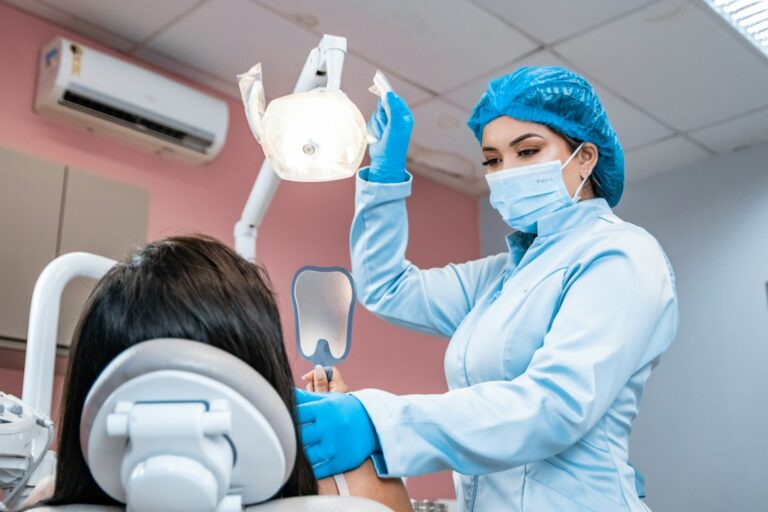
The evaluation starts by listening to what worries you and reviewing your general health. According to the UK National Health Service (NHS), the dentist asks about your general health and any problems you have had with your teeth, gums and mouth, and advises you on diet, smoking, alcohol and hygiene. Then they examine you and talk with you about treatment and follow-up (National Health Service, 2025).
Prepare a list of medications, allergies, relevant conditions and previous dental treatments. If you have pain, describe when it started, what triggers it and how long it lasts. Also share your goals: chewing comfortably again, checking a restoration or understanding whether you can replace a tooth. You don’t need to arrive with a diagnosis already decided.
The exam: checking your teeth and the tissues that support them
The exam covers your teeth, gums and the rest of your mouth (National Health Service, 2025). When evaluating the periodontium, the tissues that support the teeth, the American Academy of Periodontology checklist includes plaque, tartar, bleeding on probing, the depth of the spaces around the teeth, gum recession, mobility and bite characteristics, as well as risk factors such as diabetes or smoking. These findings provide different information from the appearance of your smile (American Academy of Periodontology, n.d.).
The general evaluation helps organize the findings. If the proposal includes seeing a specialist, ask them to explain what problem requires that involvement and what information the specialist will have.
X-rays: answering questions the eye cannot
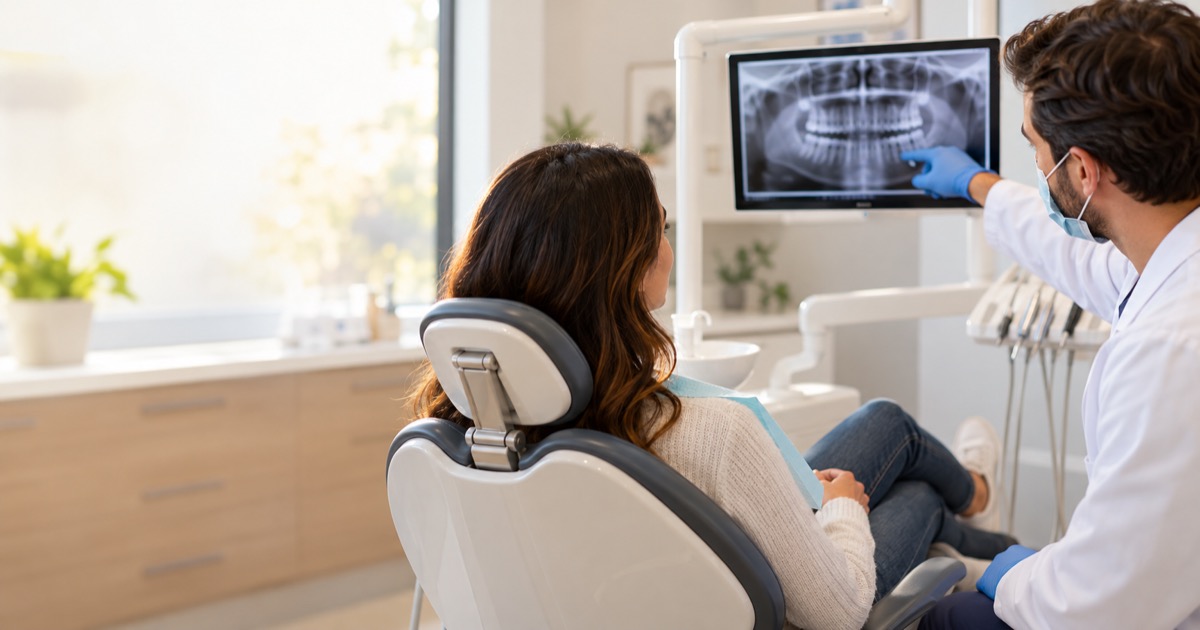
X-rays can reveal damage or disease that is not visible during the exam, such as new cavities or impacted teeth. The American Dental Association explains that the dentist decides which ones and how often after reviewing your history and your mouth, based on your oral health, age, risk and symptoms. If another dentist has X-rays of yours, ask for help sending them: the new dentist may be able to use them instead of repeating them (American Dental Association, n.d.-b).
The names describe different views:
- Bitewing: shows parts of the upper and lower crowns and the areas between the teeth in one image.
- Periapical: lets the dentist examine the root tips in the area being studied.
- Panoramic: gives a wide view of the upper and lower jaws, the teeth and nearby structures (American Dental Association, n.d.-a).
Having a panoramic X-ray does not automatically mean you have every view a case needs. The choice should relate to the clinical question and the plan, not just the number of images (Benavides et al., 2024).
What about a CT scan or CBCT?
Cone-beam computed tomography provides three-dimensional information. Its use should be justified when lower-exposure options do not provide the diagnostic information needed. The ADA safety recommendations also state that there should be a clear clinical benefit, considering the risks of exposure. It is not an automatic part of every first visit (Benavides et al., 2024).
You can ask: “What do you need to learn from this image, and how could it change the decision?” That explanation helps you understand both a proposed study and a decision not to order one.
Photos: documenting and tracking changes
Clinical photos record visible features and can help assess, treat and monitor a condition. They serve a different purpose from X-rays. If photos are taken, ask what they are for and which uses you would be authorizing. A university hospital in Leeds, for example, distinguishes three levels of consent: for the medical record only, also for teaching and research, or for publication; and it makes clear that declining does not affect your care. Rules may differ by clinic and country, so ask about theirs (Cruickshanks, 2026).
When booking an initial dental evaluation in Tijuana, confirm what the appointment includes. Ask whether the exam, imaging, photos or a cleaning are part of that visit, which depend on the evaluation and which would need another appointment. That way you can match what is offered with the care you need.
What to take with you at the end
Ask for a summary of the findings, priorities, alternatives and next steps. If something cannot be decided yet, ask what information is missing. Clarify who coordinates follow-up and when you should come back. The NHS notes that the interval between check-ups depends on your oral health and can range from three months to two years (National Health Service, 2025).
A good way to wrap up is to explain it in your own words: “I understand you found this, the first step will be that, and afterwards we’ll review these options.” If any part is unclear, there is still time to ask. The evaluation has done its job when you know what comes next and why.
Want us to review your case? At The Special Teeth we see patients in English and Spanish, about 10 minutes from the San Ysidro border crossing, and we accept Aetna and MetLife PPO dental insurance. Learn more about dental cleaning and prevention or book your evaluation.
References
American Academy of Periodontology. (n.d.). Comprehensive periodontal evaluation checklist. Retrieved October 9, 2026, from https://www.perio.org/wp-content/uploads/2019/05/CPE-Checklist_FINAL-fillable.pdf
American Dental Association. (n.d.-a). Glossary of dental terms. Retrieved October 9, 2026, from https://www.ada.org/publications/cdt/glossary-dental-terms
American Dental Association. (n.d.-b). X-rays. MouthHealthy. Retrieved October 9, 2026, from https://www.mouthhealthy.org/all-topics-a-z/x-rays
Benavides, E., Krecioch, J. R., Connolly, R. T., Allareddy, T., Buchanan, A., Spelic, D., O’Brien, K. K., Keels, M. A., Mascarenhas, A. K., Duong, M. L., Aerne-Bowe, M. J., Ziegler, K. M., & Lipman, R. D. (2024). Optimizing radiation safety in dentistry: Clinical recommendations and regulatory considerations. The Journal of the American Dental Association, 155(4), 280–293.e4. https://doi.org/10.1016/j.adaj.2023.12.002
Cruickshanks, Z. (2026, July 6). Medical and dental illustration: Clinical photography and video (Resource LN005949). Leeds Teaching Hospitals NHS Trust. https://www.leedsth.nhs.uk/patients/resources/medical-and-dental-illustration-clinical-photography-and-video/
National Health Service. (2025, April 1). Dental check-ups. https://www.nhs.uk/live-well/healthy-teeth-and-gums/dental-check-ups/
Keep reading
- How to Choose a Top-Rated Dentist and Clinic in Tijuana
- Before You Accept Dental Treatment: Questions About Costs, Alternatives and Follow-Up
- Save the Tooth or Extract It? How That Decision Is Made
Educational information. A professional evaluation determines the diagnosis and the appropriate options for each patient.