 English

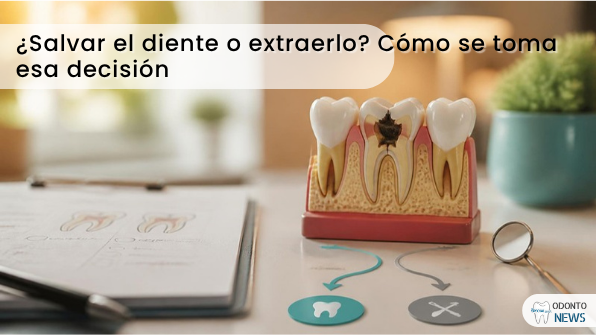
Save the Tooth or Extract It? How That Decision Is Made
The factors a dentist weighs before recommending keeping or extracting a tooth, and the questions worth asking at your appointment.
The tooth starts to hurt and, between exhaustion and worry, one idea comes up: “Just take it out.” Wanting to be done with the problem is understandable. But before deciding, it is worth pausing and changing the question: what is happening in that tooth, and what real chance does it have of continuing to work?
Saving it does not mean keeping it at any cost. Extracting it does not, on its own, prove it was the best option either. A useful decision needs a diagnosis, a prognosis and an explanation you can understand.
First: identify the problem
A deep cavity, an inflamed pulp and a fracture are not the same thing. The European Society of Endodontology clinical guideline sets the goal of relieving pain and infection and, ultimately, avoiding tooth loss. When the tooth is restorable, it considers treatments that preserve it: depending on the diagnosis, keeping the pulp alive or treating the canals. For urgent care of certain pulp and root problems, it proposes these options over extracting the tooth or prescribing antibiotics alone; that specific recommendation is based on expert consensus. None of this means every tooth can be saved (Duncan et al., 2023).
You can ask for a plain-language explanation: “Is the problem inside the tooth, around it, or both?” Also ask to be shown the finding behind the recommendation. A well-explained image usually helps more than hearing a string of procedure names.
The key question: can it be rebuilt?
Treating the canals and rebuilding the tooth address different needs. A root canal removes the damaged pulp and cleans, disinfects and seals the inside of the tooth (American Association of Endodontists, n.d.). Rebuilding, on the other hand, depends on how much healthy structure remains to support it (Blazquez, 2021). So finishing a root canal does not, by itself, answer the question of how much usable tooth is left.
Assessing whether a tooth is restorable involves several fronts: the healthy structure available, the bone and gum that support it, how difficult its canals are to treat and the role it plays in your bite. Loss of structure that reaches deep into the root or a vertical root fracture usually makes keeping it unfavorable. General health, the ability to keep it clean, the patient’s preferences and their financial situation also count (Blazquez, 2021).
“Restorable” means there is a reasonable chance of rebuilding it; it is not a guarantee of how long it will last. If the prognosis is uncertain, ask what makes it uncertain and what could clarify it. You do not have to choose only between “yes” and “no”: you can also ask how much is known and what still needs to be confirmed.
Compare two complete paths
On a sheet of paper, write “save” on one side and “extract” on the other. Under each option, ask for the stages, the estimated total cost, the visits and the follow-up. If the tooth is removed, the conversation continues: replacing it may require additional visits and even preliminary procedures (American Association of Endodontists, n.d.).
For the path of saving it, ask which restoration is planned and who will do it. For extraction, ask whether replacing the tooth is proposed, why and when. Avoid comparing the price of a single stage with that of a complete treatment: ask for estimates with the same level of detail.
Questions that keep you involved
“What concrete benefit would saving this tooth have?” “What is the main difficulty?” “What finding makes extraction advisable?” “Would the decision change after an endodontic evaluation?” Bring them in writing and ask for a summary of the plan before accepting it.
The goal is to leave understanding the recommendation, its limits and the alternatives. If a root canal is finally recommended, the next step is knowing what to expect during the procedure and what restoration the tooth will need. Saving a tooth starts with an informed decision, not with a promise that it will last forever.
Want us to review your case? At The Special Teeth we see patients in English and Spanish, about 10 minutes from the San Ysidro border crossing, and we accept Aetna and MetLife PPO dental insurance. Learn more about our treatments and reference prices or book your evaluation.
References
American Association of Endodontists. (n.d.). Root canal vs. extraction. Retrieved October 9, 2026, from https://www.aae.org/patients/root-canal-treatment/what-is-a-root-canal/root-canal-vs-extraction/
Blazquez, G. (2021). Fundamentals of restorability. American Association of Endodontists. https://www.aae.org/specialty/fundamentals-of-restorability/
Duncan, H. F., Kirkevang, L.-L., Peters, O. A., El-Karim, I., Krastl, G., Del Fabbro, M., Chong, B. S., Galler, K. M., Segura-Egea, J. J., Kebschull, M., & ESE Workshop Participants and Methodological Consultant. (2023). Treatment of pulpal and apical disease: The European Society of Endodontology (ESE) S3-level clinical practice guideline. International Endodontic Journal, 56(S3), 238–295. https://doi.org/10.1111/iej.13974
Keep reading
- Does a Root Canal Hurt? What to Expect During and After Treatment
- Do You Always Need a Crown After a Root Canal?
- Dental Implant or Bridge: How to Choose When You Are Missing a Tooth
Educational information. A professional evaluation determines the diagnosis and the appropriate options for each patient.