 English

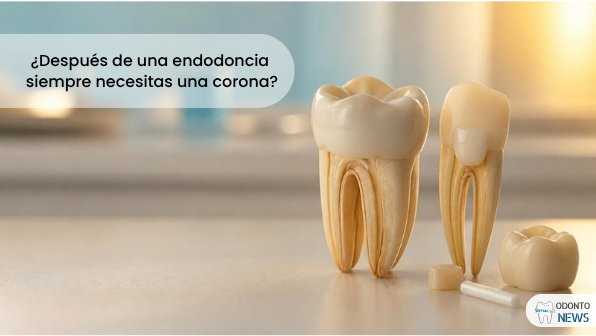
Do You Always Need a Crown After a Root Canal?
When a crown may be recommended after a root canal, and the factors that shape how a treated tooth is restored.
The root canal is finished and you feel relief. Then you hear: “Now we need to restore the tooth.” It is understandable to wonder why another stage is needed if the inside has already been treated. The answer helps you understand the complete plan and distinguish three words that often appear together in an estimate: crown, buildup and post.
The short answer: it depends on the tooth
A crown after a root canal is not mandatory for every tooth. The American Association of Endodontists (AAE) notes that back teeth, which do the work of chewing, usually need one, while incisors and canines do not always require it. In any case, the tooth needs a final restoration to protect it and restore its function (American Association of Endodontists, n.d.).
The decision considers how much healthy structure remains, the thickness of the walls, any cracks, the tooth’s position and the forces of your bite. The European Society of Endodontology recommends preserving healthy tissue and, where appropriate, considering partial restorations that cover the cusps: the raised points a molar chews with (Mannocci et al., 2021).
Two teeth with root canals may need different solutions. Asking “what is left of this tooth?” opens a more useful conversation than trying to choose a restoration by its name alone.
Crown, buildup and post: what each one does
A crown covers the tooth to restore its shape and size. The American Dental Association explains that it can strengthen a tooth with a large filling when there is not enough structure left to support it, and protect a weak tooth from breaking. Its purpose is not limited to improving appearance (American Dental Association, n.d.).
A buildup replaces part of the lost structure and can form the base on which a restoration is placed. A post is placed inside a treated canal to help retain that buildup when needed. According to the ESE, a post does not make the root stronger; whether it is indicated depends on the available tissue and the retention required (Mannocci et al., 2021).
Ask to be shown each component on a diagram or photo. That way you can link the estimate to what the tooth actually needs.
What recent research tells us
A clinical trial published in 2025 compared direct composite restorations and porcelain-fused-to-metal crowns in 60 root-filled molars that kept at least three walls over two millimeters thick; 53 patients completed follow-up. At three years, estimated survival was 93.3% with crowns and 76.7% with composites; the difference did not reach statistical significance (Abu-Awwad et al., 2025).
That does not show the two options are equivalent. The study was small and limited to teeth with little loss of structure. Composites also had worse results for decay, surface texture and marginal seal, and deteriorated over time; crowns, on the other hand, did worse on some gum and root-tip infection indicators. Clenching or grinding was associated with more failures. The authors conclude that crowns were more predictable, especially in people with bruxism, and that composite can be considered in selected cases, without meaning that any molar can be left with a composite filling (Abu-Awwad et al., 2025).
A 2025 review gathered eleven studies and found an association between indirect restorations and higher tooth survival. Observational studies predominated; the authors warn that the results should be interpreted with caution. A group-level association does not guarantee how long a restoration will last in a specific person (Kaaber et al., 2025).
How to complete treatment without getting lost between stages
After the canals are treated and sealed, a temporary filling may remain until the final restoration is placed. The AAE recommends not biting or chewing on that tooth until it is restored and getting the final restoration as soon as possible, because an unrestored tooth is at higher risk of fracture (American Association of Endodontists, n.d.).
Before you leave, ask which restoration is proposed and why, whether you need a buildup or post, who will do each step and what the estimate includes. Also clarify how to take care of yourself while you wait and when your next appointment is.
The decision is easier to understand when you can explain it in your own words: “My tooth has this much structure left, and we are going to protect it this way.” That conversation turns a list of procedures into a plan you can follow.
Want us to review your case? At The Special Teeth we see patients in English and Spanish, about 10 minutes from the San Ysidro border crossing, and we accept Aetna and MetLife PPO dental insurance. Learn more about crowns and veneers or book your evaluation.
References
Abu-Awwad, M., Halasa, R., Haikal, L., El-Ma’aita, A., Hammad, M., & Petridis, H. (2025). Direct restorations versus full crowns in endodontically treated molar teeth: A three-year randomized clinical trial. Journal of Dentistry, 156, Article 105699. https://doi.org/10.1016/j.jdent.2025.105699
American Association of Endodontists. (n.d.). Root canal explained: Step-by-step treatment guide. Retrieved October 9, 2026, from https://www.aae.org/patients/root-canal-treatment/what-is-a-root-canal/root-canal-explained/
American Dental Association. (n.d.). Crowns. MouthHealthy. Retrieved October 9, 2026, from https://www.mouthhealthy.org/all-topics-a-z/crowns
Kaaber, W., Ranjkesh, B., & Kirkevang, L.-L. (2025). Effect of type of coronal restoration on periapical healing and tooth survival of root filled teeth: Systematic review and meta-analysis. Australian Endodontic Journal, 51(3), 849–860. https://doi.org/10.1111/aej.70008
Mannocci, F., Bhuva, B., Roig, M., Zarow, M., & Bitter, K. (2021). European Society of Endodontology position statement: The restoration of root filled teeth. International Endodontic Journal, 54(11), 1974–1981. https://doi.org/10.1111/iej.13607
Keep reading
- Save the Tooth or Extract It? How That Decision Is Made
- Why Might a Tooth That Already Had a Root Canal Need More Treatment?
- Before You Accept Dental Treatment: Questions About Costs, Alternatives and Follow-Up
Educational information. A professional evaluation determines the diagnosis and the appropriate options for each patient.