 English

Why Might a Tooth That Already Had a Root Canal Need More Treatment?
Why a tooth with a previous root canal may need a new evaluation, and the alternatives a specialist may consider.
Discomfort in a tooth that has already had a root canal can prompt an immediate question: “So what was the treatment for?” Before jumping to conclusions, it helps to piece together what has changed. A previous treatment is part of the tooth’s history, but it does not on its own explain its current situation.
How can another problem appear?
The American Association of Endodontists (AAE) explains that a treated tooth may not heal properly and can hurt again months or even years later. It describes several possibilities: narrow or curved canals that were not treated, anatomy that is hard to identify, a delay in placing the final restoration or a restoration that let saliva through. New problems can also arise, such as decay that exposes the filling material to bacteria, a loose, cracked or broken crown or filling, or a fractured tooth. Not all of these situations mean the same thing, and they do not happen to every patient (American Association of Endodontists, n.d.-a).
So knowing how long it has been since the root canal helps tell the story, but it does not determine the cause. Nor does it allow anyone to claim, without an evaluation, that the previous treatment was done poorly.
First, identify the current problem
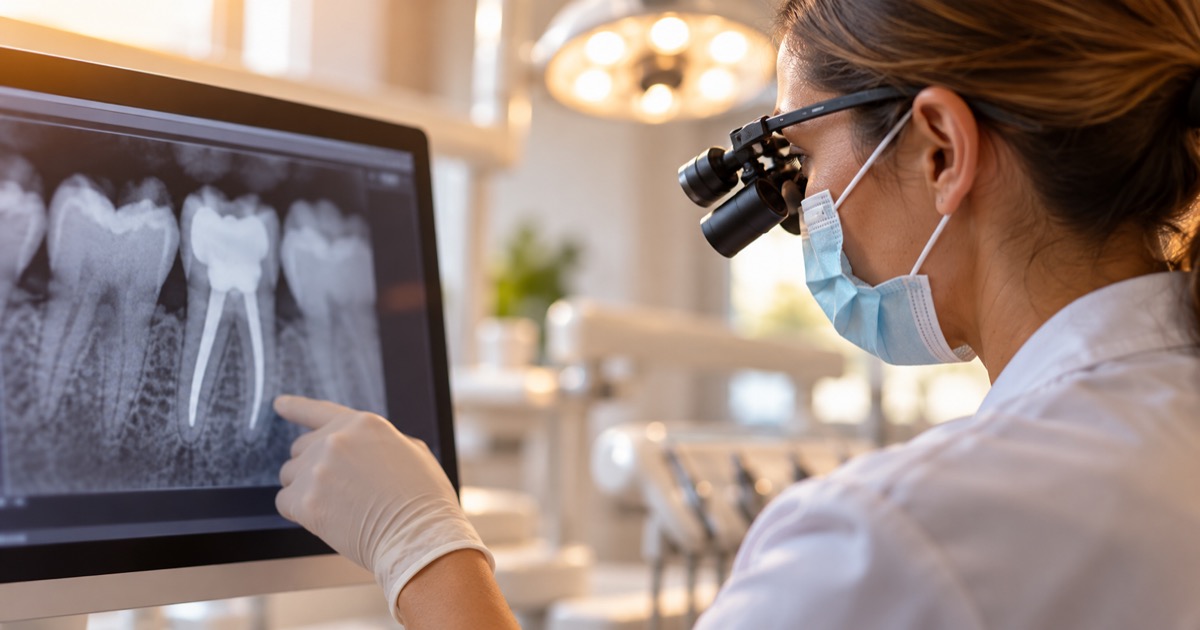
AAE standards state that persistent disease after a root canal does not automatically require extracting the tooth. A clinical evaluation and appropriate imaging can help identify the reason and determine whether retreatment is an option. These cases vary in difficulty; some require advanced knowledge and skills, and for the most complex ones the AAE favors referral to a specialist over extraction (American Association of Endodontists, 2019).
When you request the check-up, explain when the discomfort started and what comes with it. Does it hurt when you bite? Did a filling come out? Was there an injury? If you have X-rays, dates or information about the crown, bring them. That information makes for an organized conversation; it does not replace the exam.
What root canal retreatment means
In a retreatment the tooth is reopened, the materials from the previous treatment are removed and additional canals or a new infection are looked for. The canals are then cleaned, shaped and sealed again. The restoration afterwards also needs planning; the procedure does not simply end when the access is closed temporarily (American Association of Endodontists, n.d.-a).
Professional standards explain that removing posts, buildups or other materials can increase complexity. Ask what will happen to your existing restoration and which parts of the plan might need replacing. Don’t assume an existing crown can always be kept (American Association of Endodontists, 2019).
Retreat or have surgery?
They are different alternatives. Endodontic surgery may be considered when going through the canals is not enough or there are problems that require a different access. A procedure known as an apicoectomy treats the area at the tip of the root when inflammation or infection persists there. Whether it is indicated depends on the evaluation; it is not the mandatory next step for everyone (American Association of Endodontists, n.d.-b).
A useful question is: “What finding makes this option better for my tooth?” Also ask them to explain its limits, the alternatives and how progress will be checked. The possibility of saving a tooth should be assessed together with its overall condition, without promising results.
Leave with a plan you can follow
Before accepting, clarify what each stage includes, who will do the final restoration and when you should come back. Keep the instructions and a contact for later questions. Understanding why another procedure is proposed helps you decide with information instead of reading every bit of discomfort as a failure. To continue, review the difference between a crown, a post and a buildup, and how the choice between saving and extracting a tooth is made.
Want us to review your case? At The Special Teeth we see patients in English and Spanish, about 10 minutes from the San Ysidro border crossing, and we accept Aetna and MetLife PPO dental insurance. Learn more about root canal treatment in Tijuana or book your evaluation.
References
American Association of Endodontists. (n.d.-a). Endodontic retreatment. Retrieved October 9, 2026, from https://www.aae.org/patients/root-canal-treatment/endodontic-treatment-options/endodontic-retreatment/
American Association of Endodontists. (n.d.-b). Endodontic surgery. Retrieved October 9, 2026, from https://www.aae.org/patients/root-canal-treatment/endodontic-treatment-options/endodontic-surgery/
American Association of Endodontists. (2019). Treatment standards. https://www.aae.org/specialty/wp-content/uploads/sites/2/2019/11/TreatmentStandards_2019.pdf
Keep reading
- Do You Always Need a Crown After a Root Canal?
- Save the Tooth or Extract It? How That Decision Is Made
- Does a Root Canal Hurt? What to Expect During and After Treatment
Educational information. A professional evaluation determines the diagnosis and the appropriate options for each patient.