 English


Black Teeth: When a Dark Smile Was a Symbol of Beauty in Japan
For almost a thousand years in Japan, dyeing the teeth black was a sign of elegance. How it was done, whether it prevented decay and the empress who helped end it.
In 1873 the Empress of Japan appeared in public with white teeth. For a married woman of the court, that broke a centuries-old tradition. The gesture looks small, but it marked the beginning of the end of a custom that had defined beauty in Japan for almost a thousand years.
The custom was called ohaguro: dyeing the teeth black. To modern eyes it may look like a Halloween costume. To those who practised it, it was exactly the opposite: a sign of elegance, maturity and good taste.
A smile from the court
No one knows exactly when ohaguro began. The earliest written mentions appear in the court literature of the Heian period: The Tale of Genji, from the 11th century, and a 12th-century story about a young aristocrat who refused to follow the fashion and scandalised everyone with her white teeth.
At court, noble men and women blackened their teeth on coming of age, at around 13 to 16. The Kyoto National Museum lists it among the cosmetic practices of the old aristocracy, used by both men and women. It was often paired with hikimayu: shaving the eyebrows and painting them higher on the forehead.
From aristocrats to married women
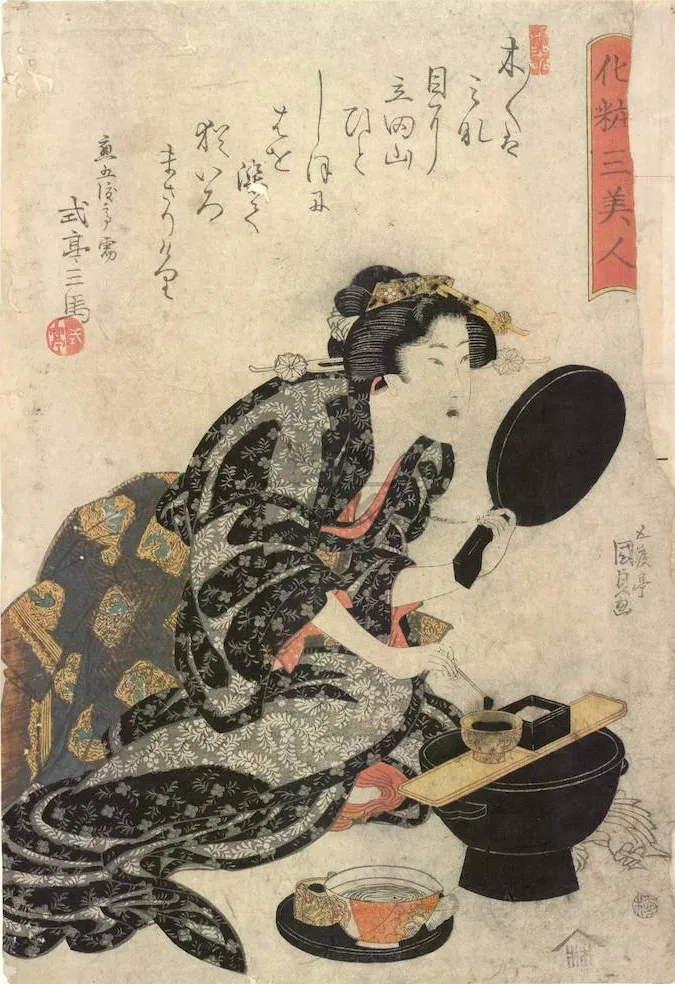
Over the centuries the custom moved from the court into wider society. In the Edo period, from the 17th to the 19th century, ohaguro became the mark of married women. A young woman dyed her teeth when she married, and the black smile announced her new status. Among men, by contrast, it was limited to the imperial family and high nobility.
It was not a one-off: it had to be repeated often because the colour wore away. It was part of everyday grooming, like hairstyling or make-up.
The chemistry of a black smile
The dye was made with a solution called kanemizu: iron filings dissolved in vinegar or tea. When the teeth were painted with it and then with a tannin-rich powder of plant galls called fushi, the iron and tannins reacted to form a black coating that did not wash off with water. It is the same chemical reaction that gives colour to iron gall ink, used for centuries of manuscripts.
The twist: a protective coating?
As early as 1609, the Spanish official Antonio de Morga wrote from the Philippines, where a similar custom existed, that the dye preserved teeth into old age. Some modern authors have suggested that the tannin-and-iron layer worked as a kind of sealant against decay.
The hypothesis is appealing but unproven. Historian Thomas Zumbroich, who has studied teeth blackening across Asia and Oceania, documents that many cultures saw it as a way to strengthen teeth and gums, although the main motive was rarely medical. There are no modern clinical studies confirming a protective effect. What we do know is that real protection against decay depends mainly on fluoride brushing, diet and check-ups.
The end of a custom
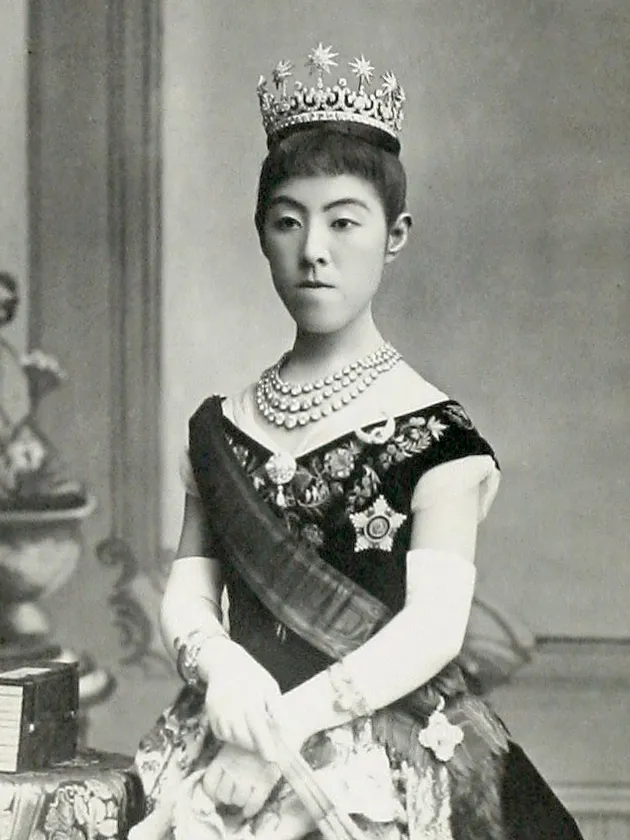
Japan’s opening to the West changed its ideals of beauty. In 1870 the new Meiji government banned ohaguro for men. Three years later Empress Shōken appeared in public with white teeth, and noblewomen and city women began to abandon it.
It did not vanish overnight. Among the middle classes and in rural areas it survived until the late Meiji period, and after the Taishō period, around 1926, only some elderly countrywomen kept it.
What is known and what is still debated
Documented:
- Ohaguro appears in Japanese literature from the 11th century.
- In the Edo period it was the mark of married women.
- It was banned for men in 1870 and declined after the empress’s gesture in 1873.
- Similar practices existed in Vietnam, Southeast Asia, Oceania and Madagascar.
Still debated:
- The exact origin of the custom.
- Whether the dye really protected against decay.
Smiles change with fashion; health does not
Ohaguro is a reminder that a “beautiful smile” depends on the era. Today we link beauty with white, straight teeth; for centuries in Japan, white teeth on a married woman could look careless. Health, however, does not go out of fashion. A necessary warning: do not try to recreate these mixtures at home; iron and acids can damage enamel and gums. If acid wear worries you, read Dental erosion: how acids wear down your teeth without you noticing.
For a thousand years a black smile meant elegance. One public appearance by an empress was enough for it to start looking strange.
Sources
- Kyoto National Museum — cosmetic practices of the aristocracy
- Zumbroich, T. J. “To Strengthen the Teeth and Harden the Gums: Teeth blackening as medical practice in Asia, Micronesia and Melanesia”. Ethnobotany Research and Applications
- Zumbroich, T. J. “The Ethnobotany of Teeth Blackening in Southeast Asia”. Ethnobotany Research and Applications
- Ohaguro — overview with references to Chamberlain (1890), Freeman-Mitford (1871) and Ashikari (2003)